WRITTEN BY: Sveta Karniyenka
Comparing employer brand perception across Western tech companies and Chinese tech champions – through the eyes of Chinese talent on Xiaohongshu.
Key Findings
- Microsoft (7.37) and ByteDance (7.15) lead employer brand perception among China’s tech talent, separated by just 0.22 points on Link Humans’ Employer Brand Index (EBI), based on Q1 2026 Xiaohongshu data.
- DeepSeek scores 4.48 — below every tech MNC in the study and level with Huawei (4.39) and BYD (4.41) — despite producing 2025’s most talked-about AI breakthrough. Salary inversion, not overwork, is its dominant negative theme.
- Microsoft and Apple outscore Huawei and BYD on every attribute with sufficient data volume, by margins of 2.11 to 2.98 points overall.
- ByteDance beats both MNCs on only two of nine comparable attributes — Benefits & Perks and Change & Stability — winning on lifestyle and momentum rather than across the board.
- Tech MNCs hold their largest advantages on sustainable-career attributes: Learning & Development, Career Progression, Job Satisfaction, and Balance & Wellbeing.
- Xiaohongshu now accounts for 52.2% of all China employer brand commentary in the EBI dataset, up from 40.1% in 2024 — making it the single most important employer brand signal in China.
The battle for tech talent is intensifying everywhere – but nowhere more fiercely than China. According to McKinsey, China faces a shortage of four million AI professionals by 2030. Against a backdrop of geopolitical tension, US-China tech decoupling, and a government push for semiconductor self-sufficiency, the talent competition in China has acquired a strategic dimension that extends well beyond recruitment. In a market this competitive, employer brand is not a communications exercise. It is a strategic talent acquisition tool.
For years, the assumption was that technology multinational corporations (MNCs) operated in their own league in China – competing primarily against each other for the country’s most skilled professionals. That assumption is now outdated. The emergence of ByteDance, Huawei, BYD, and a new generation of AI-native companies has fundamentally changed the competitive landscape. The question is no longer whether foreign tech firms can outcompete each other for talent. It is whether they can compete with Chinese domestic employers at all.
To find out, we went directly to where Chinese talent speaks most candidly: Xiaohongshu. China’s fastest-growing social platform has become the primary arena for employer brand conversation – from campus recruitment experiences and day-in-the-life posts to unfiltered commentary on layoffs, restructuring, and R&D closures. Critically, it is where talent compares employers, weighs up offers, and makes career decisions in public. While Xiaohongshu skews toward young female professionals in Tier 1 cities, it remains the most active platform for employer brand discourse among China’s most mobile tech talent – making it the most strategically relevant employer brand signal available.
| Xiaohongshu mentions grew 78.6% year-on-year. By 2025, over half (52.2%) of all China employer brand commentary in our dataset came from Xiaohongshu, up from 40.1% in 2024. |
Our research question was deliberately specific: which domestic employers, if any, are outperforming tech MNCs on employer brand perception in China – and on exactly which dimensions? The answer, as the data show, is more nuanced – and more actionable – than the prevailing narrative suggests. MNCs are not uniformly losing. But they are not uniformly winning either.
What We Measured and How
We analysed Q1 2026 data from Xiaohongshu, isolating commentary tagged to China locations only – filtering out non-China locations to ensure scores reflect domestic employer brand perception rather than global sentiment.
Relevance filtering was a critical first step. Not all Xiaohongshu commentary mentioning a company relates to the employment experience. Using ML and NLP models fine-tuned on employer brand commentary, we isolated only content directly relevant to the workplace – removing product reviews, consumer complaints, and general brand discussion before scoring. We then conducted sentiment analysis to identify the most frequent positive and negative topics driving scores for each employer.
We applied Link Humans’ Employer Brand Index (EBI) – scoring sentiment across 16 attributes from Balance & Wellbeing to Innovation & Technology – to produce comparable scores across all companies. The overall EBI score is the weighted average of all 16 attributes, with the volume of data serving as the weight. Attributes with low mentions were excluded from direct comparison to ensure statistical reliability.
Selecting the Tech MNC Cohort
Our tech MNC selection followed two criteria: companies needed significant local engineering or R&D operations in China, and sufficient Xiaohongshu mention volume to generate statistically reliable scores.
This led us to focus on two Western tech MNCs:
- Microsoft – Microsoft Research Asia in Beijing is one of the world’s leading AI research labs, making Microsoft a direct competitor for the same engineering and AI talent sought by Chinese domestic companies
- Apple – included with the caveat that Apple’s China operations skew toward hardware engineering and operations rather than software R&D, representing a distinct but legitimate tech MNC employer profile in China
Four other Western tech companies were considered and excluded:
- Tesla was initially included but generated only 43 mentions – insufficient for reliable scoring. Its near-absence from Xiaohongshu employer brand conversation is itself noteworthy, suggesting Tesla has not yet built a meaningful employer brand presence in China’s domestic talent market
- Google‘s services have been largely inaccessible in mainland China since 2010. Its Xiaohongshu commentary predominantly reflects aspirational overseas career discussion rather than domestic employer brand perception
- Amazon exited the Chinese consumer market in 2019, and its remaining AWS presence does not generate sufficient domestic employer brand commentary
- IBM closed its China R&D facilities in recent years, generating significant negative Xiaohongshu commentary in the process – and was excluded from the MNC cohort as a result
This pattern of Western tech withdrawal from China’s talent market is itself a significant finding. It provides context for understanding why domestic employers have been able to grow their employer brand momentum so rapidly – and why the MNCs that remain face a more concentrated competitive landscape than they did ten years ago.
Selecting the Chinese Comparison Companies
We selected tech companies representing four distinct domestic employer profiles, deliberately avoiding a monolithic “Chinese employer” benchmark that would obscure the most important finding in the data:
- ByteDance – China’s leading internet and AI company, and the most discussed employer among young tech talent on Xiaohongshu
- Huawei – China’s national tech champion, representing the established domestic tech employer experience
- BYD – China’s largest EV manufacturer, representing the manufacturing and hardware engineering talent market
- DeepSeek – China’s most prominent emerging AI employer, generating significant Xiaohongshu commentary following its R1 model launch. Represents the next generation of domestic tech employers that tech MNCs have not previously needed to benchmark against
What the Data Show
As the chart below shows, Microsoft and ByteDance lead the field – and the gap between them is just 0.22 points on a 0-10 scale. Neither prevailing narrative holds up: tech MNCs are not broadly losing, and Chinese employers are not broadly winning. The picture is more specific, and more actionable, than either story suggests.
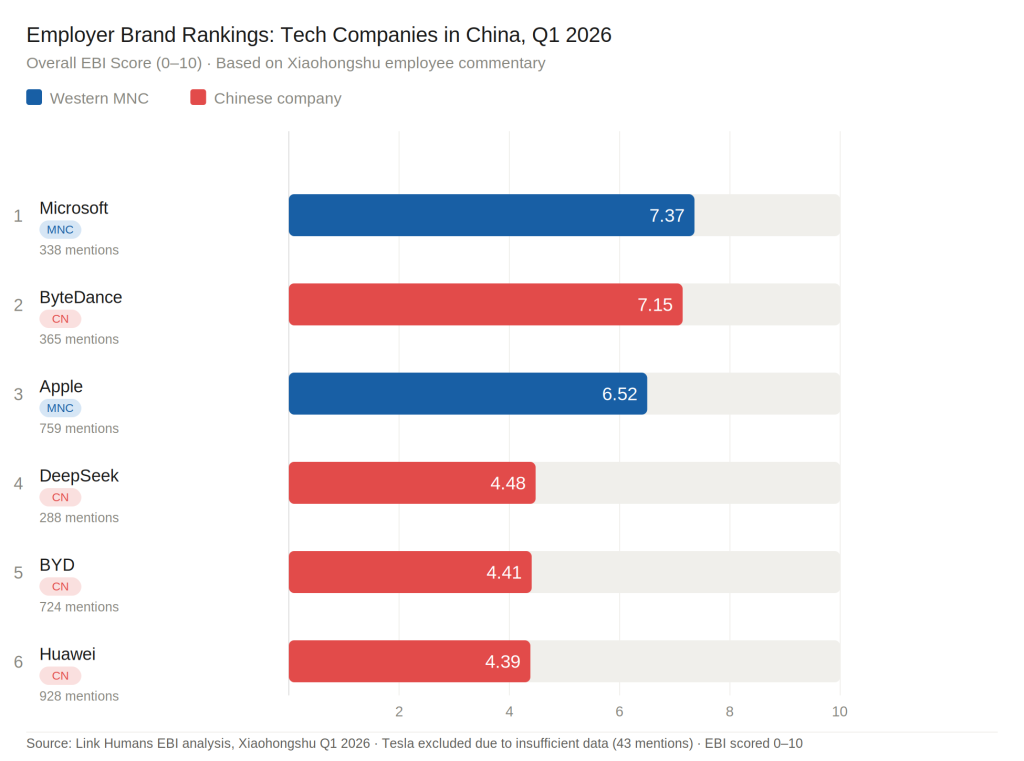
A clear three-tier structure emerges from the data:
- Tier 1 – Microsoft (7.37) and ByteDance (7.15): separated by 0.22 points, one Western, one Chinese, both significantly ahead of the field
- Tier 2 – Apple (6.52): a global tech icon with significant China operations, but trailing the Tier 1 employers by a meaningful margin
- Tier 3 – DeepSeek (4.48), BYD (4.41), Huawei (4.39): clustered within 0.09 points of each other, despite representing very different companies with very different reputations
| Rank | Company | Type | EBI score (0–10) | Tier |
|---|---|---|---|---|
| 1 | Microsoft | Tech MNC | 7.37 | Tier 1 |
| 2 | ByteDance | Chinese tech | 7.15 | Tier 1 |
| 3 | Apple | Tech MNC | 6.52 | Tier 2 |
| 4 | DeepSeek | Chinese tech | 4.48 | Tier 3 |
| 5 | BYD | Chinese tech | 4.41 | Tier 3 |
| 6 | Huawei | Chinese tech | 4.39 | Tier 3 |
The Tier 3 clustering is the most striking finding in the overall scores. DeepSeek – the company that produced the most talked-about AI breakthrough of 2025 – scores at the same level as BYD, a manufacturer notorious on Xiaohongshu for poor working conditions, and Huawei, a company famous for exceptional pay but an unsustainable human cost. This convergence is not a coincidence. It reflects three different employer brand problems arriving at the same score from three different directions: unresolved internal tensions at DeepSeek, a deeply embedded manufacturing culture at BYD, and a high-reward, high-depletion model at Huawei. The implications for each are explored in the sections that follow.
The 0.22-point gap between Microsoft and ByteDance is deceptively narrow. Beneath the surface, the two employers are offering fundamentally different value propositions. Where ByteDance wins – on Benefits & Perks (+1.36), Change & Stability (+0.23) – it wins on lifestyle and momentum. Where Microsoft wins – on Job Satisfaction (+1.61), Learning & Development (+1.19), and Balance & Wellbeing (+1.08) – it wins on attributes that matter more to talent with longer career horizons. Neither employer is universally superior. Each offers a different value proposition – a theme explored in the ByteDance Reality Check.
The ByteDance Reality Check
Among the nine attributes with sufficient volume for reliable comparison, ByteDance outscores both Microsoft and Apple on exactly two: Benefits & Perks and Change & Stability. These are its strongest advantages – and together they tell a coherent story about what makes ByteDance compelling to Chinese tech talent. This is not a company winning the employer brand battle comprehensively. It is winning it on lifestyle and momentum.

Benefits & Perks (+1.36 vs. Microsoft, +1.19 vs. Apple)
ByteDance’s perks are not listed in a handbook. They are lived and posted. The office cafeteria is described repeatedly as a “foodie’s paradise” – breakfast, lunch, and dinner, with a variety that employees photograph and share. Unlimited snacks and afternoon tea. On-site gyms with complete equipment. Housing subsidies that meaningfully reduce commuting stress. Travel subsidies paid equally to interns and full-time staff – a detail that signals respect rather than hierarchy. Global team trips to Japan, Thailand, and the US. A 10-year US visa as a company benefit.
These are not perks. They are a lifestyle proposition – and for talent in their 20s and 30s weighing career options, lifestyle propositions get posted, shared, and remembered far more than salary figures do.
Change & Stability (+0.23 vs. Microsoft, +2.64 vs. Apple)
This is the most counter-intuitive finding in the dataset. ByteDance operates at a relentless pace, has undertaken restructuring and layoffs in recent years, and is not immune to the volatility that defines China’s tech sector. Yet it scores above both MNCs on Change & Stability – dramatically so in Apple’s case.
The explanation lies in how employees interpret instability. At ByteDance, change is experienced as momentum rather than threat. The company continued aggressive hiring through its restructuring – particularly in AI – signalling that disruption comes with opportunity, not risk. Employees who leave do not post in bitterness. They post retrospectives: growth timelines, lessons learned, thanks given.
Apple’s notably low score (5.19) reflects a different anxiety — one specific to its China context. Employees and job-seekers cite concerns about Apple’s long-term R&D commitment to China, the dominance of contract and outsourced roles, and geopolitical uncertainty around Apple’s supply chain. For talent considering a career there, the question is not “will ByteDance survive?” It is “will Apple still have meaningful technical work in China in five years?” Microsoft, by contrast, scores closely to ByteDance on this attribute (7.60 vs. 7.83) – its deep research presence in Beijing giving it a stability narrative that holds its own against ByteDance’s momentum story.
Where Tech MNCs Win: The Sustainable Career Advantage
ByteDance wins on energy and lifestyle. Tech MNCs win on longevity – and both Microsoft and Apple outperform ByteDance on the four attributes that matter most for a sustained career: Balance & Wellbeing, Career Progression, Job Satisfaction, and Learning & Development. These are not random wins. They cluster around a single coherent narrative: tech MNCs offer a career you can sustain.
Learning & Development and Career Progression
Both Microsoft (7.06) and Apple (7.74) lead ByteDance (5.87) on Learning & Development – Apple’s advantage of 1.87 points is the largest MNC win across any attribute in this comparison. On Career Progression, Apple leads most sharply (8.33 vs. ByteDance’s 6.82), suggesting that Apple’s structured career ladders resonate strongly with employees despite its other perception challenges.
At ByteDance, you are thrown into real work from day one and expected to perform. That is exhilarating for some. For others – particularly as careers mature beyond the first three to five years – the absence of structured development infrastructure is a genuine concern. Structured programmes, global exposure, cross-functional paths, and access to international best practice are differentiators that ByteDance does not yet match in employee perception.
Job Satisfaction and Balance & Wellbeing
ByteDance’s intensity is a double-edged sword. The same culture that generates extraordinary motivation also generates burnout. Xiaohongshu commentary on ByteDance frequently acknowledges the pace as unsustainable beyond a certain point – it is a place to sprint, not run a marathon. Both MNCs score higher on Job Satisfaction and Balance & Wellbeing, reflecting working environments where pressure exists but does not dominate.
Not every talented professional in China wants to work at maximum intensity indefinitely. A significant cohort – particularly professionals in their 30s with families or a longer career horizon – actively seeks employers who offer ambition without attrition. That is an audience tech MNCs are well positioned to own, and one they are currently under-leveraging in their China employer brand communications.
The Opportunity This Creates
Tech MNCs score higher than ByteDance on the attributes that define a sustainable career – Learning & Development, Career Progression, Job Satisfaction, and Balance & Wellbeing. ByteDance leads on Benefits & Perks and Change & Stability. The data produce a specific competitive picture: meaningful MNC advantages on career sustainability, measurable gaps on immediate employee experience. Understanding precisely where each gap sits, and how it moves over time, is the starting point for any employer brand strategy that intends to compete for the same talent.
The DeepSeek Paradox
DeepSeek’s R1 model launch sent shockwaves through the global AI industry in early 2025. Valuations were questioned, strategies were rewritten, and China’s AI capability was suddenly taken seriously in boardrooms from San Francisco to London. On Xiaohongshu, however, a different conversation was taking place.
DeepSeek scores 4.48 overall. That places it below every tech MNC in this study and level with Huawei and BYD – companies with well-documented employer brand problems. For the company that arguably produced the most significant AI breakthrough of the year, this is a striking finding.
The Contradiction at the Heart of DeepSeek’s Employer Brand
The qualitative data reveal a company at war with itself. On one side: genuine excitement. Employees and observers praise DeepSeek’s technological achievements enthusiastically – its efficiency breakthroughs, open-source contributions, and strategic focus on AI agents generate real energy among China’s tech talent. Compensation is acknowledged as exceptional, with salaries cited at levels that are forcing competitors to rethink their own pay structures. The opportunity to work at the frontier of global AI development is a powerful draw.
On the other side: a specific, recurring, and damaging grievance. The dominant negative theme in DeepSeek’s Xiaohongshu commentary is not overwork, not poor management, not lack of career development. It is salary inversion – the practice of paying new external hires significantly more than long-serving employees doing equivalent or more valuable work.
The departure of Guo Dayan – a respected senior researcher and one of DeepSeek’s earliest technical hires – became a focal point for this frustration. His exit crystallised a broader anxiety: that DeepSeek’s aggressive external hiring strategy, while effective at attracting marquee talent, is actively undermining the loyalty and morale of the people who built the company. The perception – expressed repeatedly on Xiaohongshu – is that veteran employees are treated as replaceable the moment a more expensive external hire becomes available.
A Second Structural Problem: Strategic Instability
Compounding the pay inversion issue is a technology strategy that employees have flagged as disruptive and poorly communicated. The decision to shift from CUDA – Nvidia’s widely-used computing platform – to Huawei’s Ascend chips, driven by US export controls rather than technical preference, generated significant negative commentary around Change & Stability. Employees are not criticising the decision itself so much as the way it was managed: abruptly, without sufficient support for the teams affected, and in a way that signalled that strategic pivots take priority over internal continuity.
What This Means for Tech MNCs
DeepSeek’s employer brand problems create a clear window for tech MNCs. The company is still rapidly scaling, and its issues may resolve as it matures. But in Q1 2026, the talent that might otherwise be lost to DeepSeek is actively questioning whether the reality matches the hype. Tech MNCs that can offer structured career development, transparent and equitable compensation, and genuine long-term stability have a credible counter-narrative – and a window to use it.
The most effective employer brand message a tech MNC can deliver to a talented engineer considering DeepSeek right now is not “we are more exciting.” It is: “We will still respect you in five years.”
Microsoft and Apple vs. Huawei and BYD: A Clear MNC Advantage
The comparison with Huawei produces the most unambiguous finding in this study. Microsoft and Apple outscore Huawei and BYD on every valid attribute. Microsoft leads Huawei by 2.98 points overall and BYD by 2.96, Apple leads Huawei by 2.13 points and BYD by 2.11. This is not a close competition.

Huawei: High Rewards, Unsustainable Cost
Huawei’s employer brand is defined by a single, powerful tension: the compensation is exceptional, but the human cost of earning it is widely considered too high.
The infamous “45-year-old rule” – compulsory retirement or contract non-renewal around age 40 to 45 – generates persistent and high-volume negative commentary. For employees who have given their prime working years to the company, the prospect of forced exit at the height of their earning power is experienced not as a retirement but as a disposal.
The working culture compounds this. The 996 schedule – 9am to 9pm, six days a week – is not merely accepted at Huawei but socially enforced. Employees describe staying late not because the work demands it, but because leaving early carries a social penalty. The result: burnout, missed family milestones, and a recurring sense of being a machine rather than a person.
Management is a third pressure point. The phrase that appears most consistently is not a complaint about overwork – it is “more managers than doers.” Endless coordination meetings, bureaucratic approval chains, and middle managers who protect territory rather than develop people create a working environment where the actual work feels secondary to the politics around it.
Perhaps most damaging for its long-term talent position: Huawei’s internal technology is widely described by its own engineers as closed, backward, and skills-limiting. The company that built global 5G infrastructure is perceived, from the inside, as a place where you cannot learn real software skills. The phrase heard from a manager – “we don’t train, we screen” – has become a shorthand for an entire cultural philosophy that prioritises extraction over development.
BYD: When a Factory Becomes a Tech Company in Name Only
BYD’s employer brand problem is categorically different from Huawei’s – and in some respects more severe. Huawei’s negatives are the side effects of genuine ambition. BYD’s negatives point to something more fundamental: a manufacturing culture that has not evolved to meet the expectations of the knowledge workers it is now trying to attract.
The dominant employer brand narrative on Xiaohongshu is not pressure or intensity. It is incompetence and exploitation. Employees describe being managed by what they characterise as unqualified leaders in a system that is chaotic, inconsistent, and punishing – not because the company is demanding too much, but because it is demanding it badly. Employees describe long hours, low base salaries relative to the time demanded, and a sense that the company is extracting maximum output with minimum investment in its people.
The Brazil incident – in which workers at a BYD construction facility were found living in conditions described as analogous to forced labour – surfaces repeatedly in the Xiaohongshu commentary as evidence of an institutional attitude toward workers that extends beyond China.
BYD is building some of the world’s most advanced electric vehicles. It has not yet built a workplace that the people assembling them – or the engineers designing them – want to stay in.
What This Means for Tech MNCs
The Huawei and BYD data are clarifying rather than merely reassuring.
The narrative that Chinese employers are broadly outcompeting MNCs for talent does not hold up against the evidence. On the attributes that define sustainable, meaningful employment – career development, job satisfaction, management quality, workplace environment – MNCs score significantly and consistently higher than both Huawei and BYD. That advantage is not marginal. It is structural, and it is visible in the data.
What the data also show is that Huawei and BYD’s employer brand problems are not hidden. They are extensively documented, openly discussed, and widely understood among Chinese tech talent on Xiaohongshu. The negative commentary around Huawei’s 45-year-old rule, BYD’s management culture, and both companies’ approach to employee welfare is high-volume and high-emotion.
The implication for MNCs is not that the battle is won. It is that the competitive advantage exists in the data – and the question is whether it exists with equal clarity in the minds of the talent MNCs are trying to reach.
Conclusions
This study examined employer brand perception across six tech companies operating in China’s domestic talent market, using Xiaohongshu commentary as the primary data source and the Link Humans EBI framework as the measurement instrument. The findings challenge two prevailing assumptions: that tech MNCs are broadly losing China’s talent war, and that domestic employers represent a uniform competitive threat.
Microsoft and ByteDance lead the field, separated by 0.22 points. Both MNCs outperform Huawei and BYD on every valid attribute. DeepSeek, despite its technical prominence, scores at the same level as companies with well-documented employer brand problems. The competitive landscape is company-specific and attribute-specific. ByteDance outperforms MNCs on lifestyle and momentum. MNCs outperform ByteDance on the attributes that define sustainable careers. These are not equivalent propositions – they reflect genuinely different employer value propositions, legible only at the attribute level.
The attribute-level picture is where the strategic value lies. The 0.22-point overall gap between Microsoft and ByteDance masks a 1.36-point gap on Benefits & Perks in ByteDance’s favour and a 1.61-point gap on Job Satisfaction in Microsoft’s favour. Two employers nearly identical in overall score are offering meaningfully different experiences across the dimensions that matter most to different talent segments. Aggregate employer brand scores are useful for orientation. Attribute-level EBI scores are what make strategy possible.
The most important finding in this study is not a number. It is a reframing. The question tech MNC employer brand leaders have been asking – “can we compete with Chinese employers in China?” – turns out to be the wrong question. The right question is: which Chinese employers are actually competing for the same talent, on which attributes, and with what measurable gaps. Asked precisely, it has a precise answer. And precise answers are where strategy begins.
Methodological Considerations
The EBI scores in this study measure employer brand perception among Xiaohongshu users – a population that skews toward female professionals in their 20s and 30s in Tier 1 cities. This demographic represents a strategically significant segment of China’s tech talent market, but findings should be interpreted with this skew in mind. EBI scores measure perception as expressed in employee commentary, not objective working conditions or talent flow outcomes – a meaningful and growing signal, distinct from hiring or retention data.
Finally, this study is cross-sectional, reflecting Q1 2026 data. Employer brand perception responds to events – layoffs, R&D closures, leadership changes – and cannot be assumed stable across quarters. The findings establish a baseline. Tracking them over time is what converts a baseline into a strategic tool.
For bespoke EBI benchmarking and quarterly tracking, contact Link Humans.
Reference
Maes, W., & Sawaya, A. (2023). How businesses can close China’s AI talent gap. QuantumBlack AI by McKinsey. https://www.mckinsey.com/capabilities/quantumblack/our-insights/how-businesses-can-close-chinas-ai-talent-gap#/
STAY CONNECTED.
DATA-DRIVEN EMPLOYER
BRAND INSIGHTS.
Our newsletter is exclusively curated by our CEO, Jörgen Sundberg, for leaders who make decisions about talent. Subscribe for updates on The Employer Branding Podcast, new articles, eBooks, research and events we’re working on.
Play Video
Recent Articles

How Layoffs Affect Employer Brand: Analysis of 13 Layoff Events, 2022–2026
When companies initiate layoffs, employer reviews begin to incorporate criticisms of more than just job security. Key Findings Management & Organization took a hit. Positive commentary about this attribute fell by around 4 percentage points in the announcement quarter, reaching...
How Pfizer Runs Its Employer Brand Like a Lab Experiment
Pfizer needs little introduction. The research-driven pharmaceutical company employs around 90,000 people across 90 countries from its New York City headquarters, and its name recognition means it rarely struggles to attract applications. But brand awareness and a full inbox aren't...